Just thought I’d upload this photo of a “beer can chicken.”. It just looked so cool sitting there on the Weber kettle.

Just thought I’d upload this photo of a “beer can chicken.”. It just looked so cool sitting there on the Weber kettle.
There’s no question that the economy is broken and healthcare is deteriorating quickly in the US. The situation isn’t going to improve any time soon. The title to this article promises quite a lot, so let’s get to it.
The system I’m going to propose involves a series of tax credits to US businesses. I can hear you groan as you read that sentence; I’m generally no fan of tax credits for businesses because in most cases our nation as a whole pays dearly for private profits. But in this case I think that it is the only way to truly stimulate our economy and fix healthcare at the same time. We’ve already seen how well the various economic stimulus packages aren’t working. We will shortly see that the healthcare reform being marched through Congress right now is only going to create incentive for businesses to pawn the healthcare of their workers off to the taxpayer.
Eligibility for tax credits: Only US corporations incorporated and headquartered within the United States of America by January 1 of the tax year are eligible to participate. The corporation must remain incorporated and headquartered in the US for the entire tax year to remain eligible. This means that any company that has moved its legal location to a tax haven like the Cayman Islands or Monaco will not be eligible. The corporation must actually report income for tax purposes to US taxing authorities. US corporations that would be eligible under this program that are sold to, merge with, or are a subsidiary of any foreign corporation are not eligible to participate in the program.
Credits: The credit system is built around the concept of “points.” Eligible corporations earn points for each goal they meet for each covered employee. Points are then multiplied by a dollar amount to determine the total tax credit. In no case will the credit result in a payment to the corporation by the US government; the tax credit can never be greater than the corporation’s normal federal tax assessment (state and local taxes are not considered as part of this program).
Employee types: Points are issued for each permanent full-time employee. Part-time employees, contractors, temporary / seasonal workers, members of the board of directors (unless otherwise considered an employee), foreign employees, and employees of any subsidiary are not counted. Foreign employees recruited under special visa programs like H1B are also not counted. Full-time equivalencies (FTE) cannot be used; the employee must be regularly scheduled to work 40 or more hours per week. Corporations cannot add part-time employees together to create one full-time employee.
Points: The items listed below constitute the points that corporations can earn. The program always earns points; no penalty is ever applied for missing a goal (other than the point isn’t earned).
Example: Let’s say that the employee’s salary is $75,000 per year. That is an hourly rate of $36.06.
Total points = 9
This is a typical full-time employee working for the ACME Widget Foundry. The ACME Widget Foundry has 40 employees. The ACME Widget Foundry earns 360 points (40 x 9 = 360). The US government sets the tax credit for each point at $100.00. Given this scenario, the ACME Widget Foundry tax credit would be $36,000.00 (360 x $100.00 = $36,000.00).
If we were to change the tax credit to $1,000.00 per point then the ACME Widget Foundry tax credit becomes $360,000.00 – a substantial amount of money for a company with just 40 employees.
Conclusion: Certainly a tax credit program like this is expensive for the employer. Implementing it shouldn’t be seen as an overwhelming expense by employers. Rather, it should be seen as contributing to their profitability. How would that happen? Employees that are in good health, that are well-educated, and that are not worried about about their family or their retirement are more innovative and more productive. Employees that are paid well will contribute to economic activity that will stimulate others to buy goods and services from the company. Corporate taxes will also be lowered because government will not be required to provide as many “public” healthcare programs (Medicare, Medicaid, and the as yet un-named program working its way through Congress) and the Social Security program can be scaled back for those citizens who have private retirement options (in other words: return Social Security to the safety-net role for which it was originally intended).
This program wouldn’t change how healthcare is delivered in the US. What it would change, however, is how healthcare is paid for. It would encourage corporations who benefit from healthy employees to pay for that rather than shifting the burden to taxpayer funded programs (like Medicare and Medicaid) or various charity systems.
You can quibble over the details (i.e. what goals earn points and how many points each goal earns) as well as the dollar amount of the tax credit for each point. You should resist the temptation to add too many goals or make the goals too complex to determine if compliance has been met. The whole program should be clear and simple to understand with no ambiguous areas to enable corporations to take advantage of the program without actually providing the benefits to employees. The idea is to provide a positive incentive for US corporations to “do the right thing.”
PS – As I thought about offering this proposal I debated whether or not “C-Level” employees and executives should be included. Their salaries will often skew the points. In the end I concluded that they are just as much of an employee of the corporation as any other and that they should be included in the calculations.
Fox News is concerned that some of the economic stimulous money is going to “porn.” See article here. Some months ago GOP senators published a list of what they considered “wasteful.” See CNN listing here. Nowhere on the list was mention of any activities from the National Endowment for the Arts (NEA). The NEA was the source of the funding that Fox and others are unhappy with.
Fox News helpfully provides a link to the official NEA list of stimulus grant recipients. See full list here. I’ve selected some grants from the list:
Alvin Ailey Dance Foundation, Inc. ($50,000)
American Boychoir School ($50,000)
California Lawyers for the Arts, Inc. ($50,000)
Cathedral Arts Projects Inc ($25,000)
Lawyers? Why do lawyers need stimulus funding from the NEA? What, exactly, do they have to do with producing art? Why isn’t Fox News indignant about lawyers? Do we really need to fund more parasites under the guise of “art?” I would think that Fox News would be all over left-leaning lawyers receiving taxpayer money.
Cathedral Arts Project appears to have a religious focus in their “art” activities. According to their web site they were by St. John’s Episcopal Cathedral. Why isn’t Fox News upset by this clear support of religious activity by the NEA? I’m probably exageratting the influence of religion in the activities of the Cathedral Arts Project; I don’t actually know anything about them other than the snippets gleaned from a quick review of their website.
While I’m not a porn consumer or afficianado of various forms of “adult entertainment,” as a taxpayer I’m not particularly concerned about something that Fox sees as “perverted.” Why? It really comes down to the First Ammendment guarantee of free speech and to the separation of church and state. While we might find the particular art form to be in poor taste, we must support the rights of the artists to create it and the rights of adults to consume it.
The NEA to be fair and respect the First Ammendment to the Constitution has to issue grants to all comers equally without regard to the perceived merits of the “art.” Of course, whether or not there should even be a National Endowment for the Arts is an entirely different debate.
While visiting Fox News (www.foxnews.com) tonight the image below kept popping up in Google Chrome:

Obviously, I appreciate Chrome asking me whether or not to allow the web site to store information on my computer. Questions, obviously, remain:
Without more information about what Fox News is attempting to do I’m always going to say “Deny” to these sorts of things.
This is new behavior. It isn’t something I’ve ever seen from Fox News. I haven’t seen any other web site attempt to use Google Gears to “store information” on my computers. Running a Google search for the phrase “The website wants to store information on your computer using Gears” doesn’t yield any useful information. Either the issue happens infrequently or no one except me cares when websites want “to store information” on my computer.
Update
Based on Matt’s comments below I did a little digging. Loomia is a “content recommendation engine” (company, Wikipedia article). It’s certainly a reasonable theory as to the source of the Gears popup. I’ll still probably continue denying the request to store information without further details as to what is being stored.
The interesting thing now is that other browsers like Internet Explorer and Firefox are not showing a similar warning. Is there some code behind the Loomia widget that behaves differently when Chrome is detected as the browser?
A few days back I wrote about the persistence of the belief that the United States of America is a “Christian Nation.” The Fox News web site is running a story today about a group that is trying to block the inclusion of the phrase “In God We Trust” on the Capital Visitor Center in Washington, DC. The Freedom From Religion Foundation is suing on the basis that engraving these words on a publicly owned facilitate would “discriminate against those who do not practice religion and unfairly promote a Judeo-Christian perspective.”
The story then quotes two Republican members of Congress:
“This lawsuit is another attempt by liberal activists to rewrite history and deny that America’s Judeo-Christian heritage is an essential foundation stone of our great nation,” said Rep. Steve King, R-Iowa.
Rep. Daniel Lungren, R-Calif., said he was expecting a lawsuit but called the claims “patently absurd.”
Christianity has certainly played an important role in the history of our nation. Many of our citizens claim to be Christian. While both of those observations are true it does not follow that government must promote such beliefs on public facilities. In fact, the Constitution specifically prohibits such promotion precisely because it would discriminate against those who do not share the same spiritual belief system or those who do not have a spiritual belief system.
I consider myself to be politically liberal and I don’t find that I’m the one trying to re-write history. Quite the contrary. I’m trying to show that people such as Rep. King and Rep. Lungren are actually the ones working to obscure the principles that actually established the system of law in the United States of America.
Since I’ve started doing more web development over the last couple of years, I’ve become much more interested in how web sites appear in different browsers. This page article is going to show how this web site, at least a small corner of it, appears in a different browsers on several operating systems. This isn’t an exhaustive review of any of the browsers. It’s really just to demonstrate the appearance of one web page in various browsers.
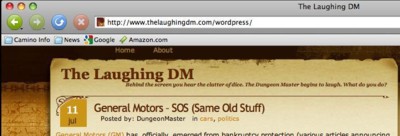


Chrome on Mac OS X is still a beta, so it isn’t quite as robust as its Windows counterpart.
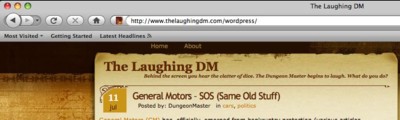

I’ve been finding lately that the latest version of FireFox (3.5) on Windows takes a long time to load. So long, in fact, that I often end up starting additional instance because I think that I somehow missed clicking on the icon. Regardless of the slow load, it is hard to beat the Firebug plugin for buidling web sites.
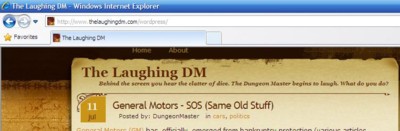
I know that Internet Explorer 8 is supposed to bring all sorts of useful and cool enhancements, but I haven’t been able to figure out what they are or how they could make my web browsing exerience more satisfying. The only thing that I’ve seen that is different is that IE8 locks up more frequently than IE7. As always, IE 8 remains the favorite (read as: only) target for third-party application browser application toolbars.

Maxthon is a browser that I recently learned about. My understanding is that it is quite popular in Asia, particularly China. I don’t really like this browser. You can’t really see if from this small screenshot, but the UI is, in my opinion, very busy. If I’m going to work on web sites that could run in any browser, it is worthwhile to work with this one.


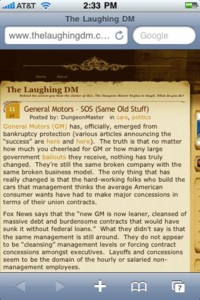

I find that my personal preference is trending towards Google Chrome on Windows (XP and Vista) and Mozilla Camino on Mac OS X.
General Motors (GM) has, officially, emerged from bankruptcy protection (various articles announcing the “success” are here and here). The truth is that no matter how much you cheerlead for GM or how many large government bailouts they receive, nothing has truly changed. They’re still the same broken company with the same broken business model. The only thing that has really changed is that the hard-working folks who build the cars that management thinks the average American consumer wants have had to make major concessions in terms of their union contracts.
Fox News says that the “new GM is now leaner, cleansed of massive debt and burdensome contracts that would have sunk it without federal loans.” What they didn’t say is that the same management is still around. They do not appear to be “cleansing” management levels or forcing contract concessions amongst executives. Layoffs and concessions seem to be the domain of the hourly or salaried non-management employees.
The real problem with GM is that they haven’t made a product that I’m interested in purchasing. I’d much rather purchase a well-made, reliable, fuel-efficient car from a company like Toyota that is willing to take risks and deliver the innovative vehicles that consumers really want. I love the fact that I can get 500 miles on a tank of gas in my Prius and do it with mileage in the 45+ range. If Toyota brought out a hydrogen or all-electric version of the Prius that could get the same range as my existing gasoline/electric hybrid, I would be at the dealership talking to sales about how I could purchase such a vehicle. If they could do it in a truck, so much the better.
Come on GM, I just said what I’m interested in buying. Are you up to the task of bringing such vehicles to the market in the US?
Sadly, I don’t think any one at GM has the imagination and willingness to risk necessary to build the vehicles that would persuade me to become a GM customer, to keep my vehicle-purchasing dollars in the US.
Many letter writers in the local newspaper, The Daily News, argue that the United States of America was founded as a “Christian Nation,” that is now a “Christian Nation,” and that it must remain a “Christian Nation.” The local writers aren’t the only ones making the argument; it appears in many newspapers, on television shows with Christian themes, and on numerous web sites. The topic of the “Christian Nation” of the USA is increasingly relevant in the modern world as many people in predominately Muslim countries see the policies and rhetoric of the USA towards them as the resurgence of the Crusades.
The argument that the United States of America is a “Christian Nation” generally proceeds from the claim that the Founding Fathers were Christians. Following from that is the observation that the Declaration of Independence contains the phrases “to which the Laws of Nature and of Nature’s God entitle them” and “they are endowed by their Creator with certain unalienable Rights” and that these, necessarily, establish that the United States of America was founded as a Christian nation [emphasis added in both quotations].
Neither the phrase “Nature’s God” nor the phrase “their Creator” specify the Christian god. “God,” in the western tradition, is often synonymous with the Christian god, though not exclusively. It can easily be used by adherents of any faith such as Christians, Jews, Muslims, Baha’is, and many others to refer to their deity. “Creator” is still more ambiguous and could be interpreted by some as the Universe itself as “their Creator.”
The Constitution, the founding and basic law of the United States of America, says only that “Congress shall make no law respecting an establishment of religion, or prohibiting the free exercise thereof” and then only in the First Amendment to the Constitution. This basic law prohibits Congress, and, by extension, state and local governments, from establishing a state religion. Government is also prohibited by the First Amendment from interfering with the religious faiths established by the citizens and the practice of those faiths. Government is to remain neutral on the subject of religion; it is to neither promote nor restrict the exercise of any particular faith nor is it to promote or restrict faiths in general.
The two documents that establish the legal basis for and the basic law of the United States of America say little about religion in the abstract and nothing whatsoever about the United States of America being founded as a “Christian Nation.”
The founders were wise to record nothing in these basic documents with respect to religion. They knew that just they had to compromise on many issues founding a new nation such as the structure of the government, the keeping of slaves, taxes, the rights of the states vs. the federal government, the role of the military, and the rights of the individual vs. the government that compromise and respect for people of all faiths, including those who did not express a faith, would be key to holding the nation of diverse beliefs together.
A quarter millennia ago the Founders were not far removed from the great religious wars of Europe. In fact, many of the Founders owed their presence in North America to to their parents and grandparents having fled religious persecution in Europe. We easily remember the Puritans, but there were many other Christian sects that felt that the freedom that North American offered was better than Europe.
Certainly, most Americans throughout history and today have self-identified as “Christian” whether they truly practice their version of the faith or not. America, perhaps more so than any other nation, has large minority populations practicing other faiths. This is a good thing; it brings strength through diversity of thought guided by varying religious principles. This is particularly true when members of different faiths are willing to compromise due to the sound ideas of others.
A major point of debate is whether or not some people who claim to be members of the Body of Christ actually are. Catholics are commonly accused of “not being Christians.” The reasoning for this accusation is beyond the scope of this discussion. If Catholics were eliminated from the numbers of self-identified Christians, it would bring the percentage of Christians in the USA down to a bare majority. According to the American Religious Identification Survey (ARIS) 2008, 76.7% of Americans are Christian (the survey is summarized here). If Catholics are removed from this number then the percentage of Americans self-identified as Christian falls to 50.9%. Other denominations are also often accused of “not being Christian.”
Unlike some nations, Americans are not required to state a religious faith to the government and be bound by that statement of faith. (Egypt is an example where religious registration is mandatory.) Consider too that because no official registration of faith is required that Americans are free to change religion at will as their own spiritual journey dictates. In some locations, particularly in Muslim areas that implement Sharia Law, it is impossible to openly change one’s faith; to do so is to invite a formal death sentence from the government or from the religious authority or to be tried and executed by local vigilantes.
The Founders did not establish a state religion or laws that allowed the state intervene in religious affairs because they feared the tyranny, repression, and violence it could propagate. Their bequest of religious freedom enables us to undertake a national spiritual journey in much the same way as individuals. We may some day become a nation of Muslims, Buddhists, Baha’is, atheists, or, even, agnostics. And that is what we truly are: a Nation of Freedom.
I know the SciFi Channel has re-branded itself as “Syfy“. The tagline says that we’re suppossed to “imagine greater.” I’m having a difficult time imagining how the change could be worse.
For example, tonight I have quite a bit of free time; my wife is out of the house at a meeting for several hours. I figured it would be a good time to turn on SciFi Syfy and watch some shows I don’t get to see that often, maybe catch something new. Instead, I was greeted with Ghost Hunters: International. The guide showed nothing but Ghost Hunters: International for the remainder of the evening. So much for watching some good scifi (note the difference in spelling). Instead, I’m spending it reminiscing about scifi and writing this posting.
But a whole day of Ghost Hunters: International? Is the amount of available science fiction material that limited that the network that has brought science fiction to cable television for so many years has to resort to a show about ghosts? And a bad one at that? (Yes, I have watched various incarnations of Ghost Hunters and they’re all bad and not believable or entertaining in the least. In fact, I have serious doubts about whether or not the show is “real.”)
I find it difficult to believe that good science fiction is hard to come by. The old SciFi Channel just finished out a phenomenal re-telling of Battlestar Galactica, for example. Even if Syfy resorted to re-running Star Trek, they could fill at least 700 consecutive hours of programming (about 30 days) with good stories. There are many other good scifi television series such as Dr. Who, Babylon 5, Farscape, Twilight Zone, Firefly, Eureka, The X-Files, and the Stargate franchise that could be shown. There are also many, many movies including the major scifi (and fantasy) franchises such as Star Trek, Star Wars, The Lord of the Rings, and Indiana Jones as well as their attendant documentaries plus all of the countless other scifi (and fantasy) films to numerous to mention that could be shown.
My wife and I did catch Syfy’s new series, Warehouse 13, last night. It was mildly entertaining. We’ll probably watch the next couple of episodes to see if it catches our interest. Caprica is coming too, but it just doesn’t look like it has enough to catch my attention. Besides, those series that go back and try to tell the ancient backstory of phenomenally successful series just aren’t that successful themselves.
If SciFi Syfy actually showed science fiction and fantasy programming, I would be watching it. I’d be watching it right now.
Syfy says that with the change in branding they can do “much more” with television, the web, games, mobile media, and what not. The only thing I want more of is scifi.
What is the iPhone image file format? When I work with the files that are on the phone I see some that are in jpg and png format. I understand the difference between the file formats. I’m just curiuous about when the iPhone creates which.